
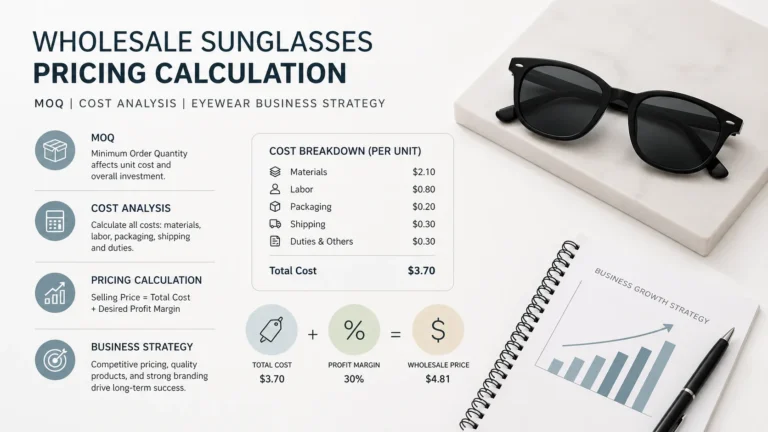
MOQs • Pricing • Landed Cost • Margins
Wholesale Sunglasses MOQ & Pricing Guide
Planning inventory and pricing for sunglasses can feel like balancing a tightrope. This guide explains wholesale sunglasses MOQ mechanics and gives you a usable sunglasses pricing guide you can apply to capsules, seasonal drops, and larger retail buys. Expect clear examples, cost formulas, and negotiation tips that help you protect margin without overcommitting to inventory.
If you need quick answers, see our FAQ. For custom options like logo printing or packaging, visit Custom Service. Ready? Contact Us.
Why MOQ Matters More Than Price Per Unit
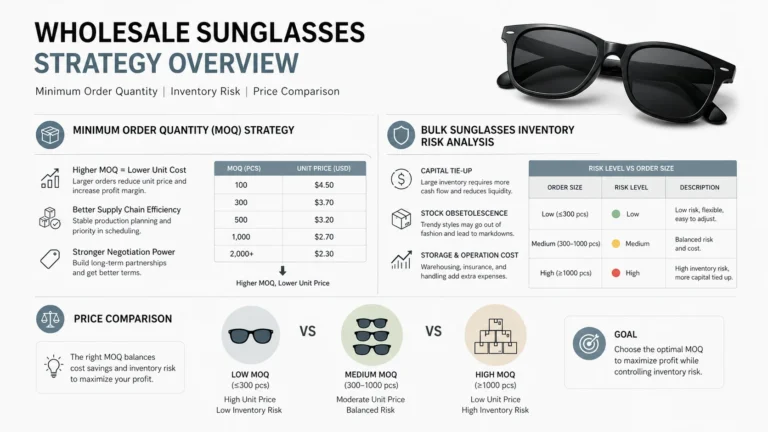
MOQs (minimum order quantities) affect tooling amortization, color batching, and freight economics. A lower per‑unit price at a higher MOQ may still leave you cash‑strapped. Conversely, a higher per‑unit price at a low MOQ might be smart for testing a market.
I often tell new brands: treat MOQ as a strategic lever. Use small capsules to validate demand and then scale. If a supplier insists on high MOQs without showing cost breakdowns, you’re buying risk, not value.
Typical MOQs by Category
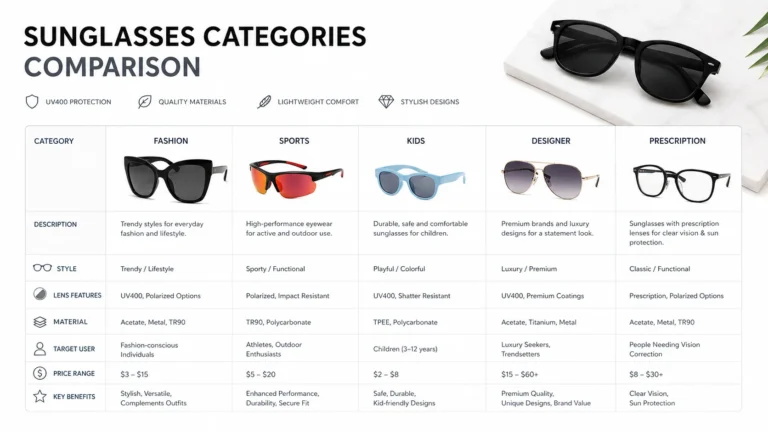
These numbers are working conventions. Styles, finishes, and materials change them. Use this as a planning baseline.
| Category | Typical MOQ / Style | Colors | Why |
|---|---|---|---|
| Standard Fashion Sunglasses | 300–600 | 2–3 | Shared hardware and lenses reduce costs |
| Sports / Wrap | 300–600 | 2 | Special lenses and venting increase tooling |
| Prescription Sunglasses | 200–400 | 1–2 | Lens fitting and RX insertion complexity |
| Designer / Limited | 150–300 | 1–2 | Hand finish increases per‑unit cost |
| Kids | 300–600 | 2–3 | Tighter safety testing and smaller runs |
Want to start smaller? Consider ODM routes or shared component strategies to lower initial costs. See examples in our Case Studies.
How to Read a Cost Breakdown
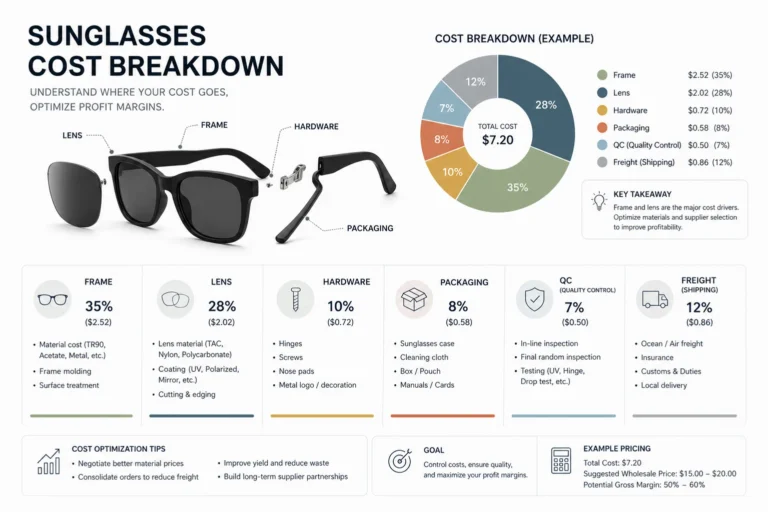
Suppliers often give a single per‑unit price. Ask for a cost breakdown. A transparent breakdown looks like this:
- Frame cost — acetate or metal, per unit.
- Lens cost — polarized, mirror, photochromic add cost.
- Hardware — hinges, screws, logo hardware.
- Finishing — buffing, plating, coating.
- Packaging — case, box, insert, barcode labels.
- QC & testing — per‑unit sample checks and lab costs amortized.
- Freight allocation — per‑unit share of the container or air freight.
When you see these numbers, you can model margins and decide where to spend for hero SKUs. For example, spending an extra $1.50 on lenses for a hero color often yields better sell‑through than adding more SKU variety.
Practical Pricing Models (Wholesale → MSRP)
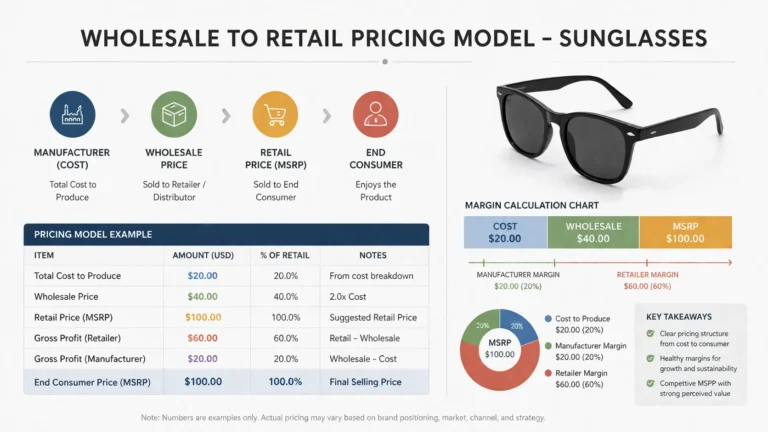
Here are two simple approaches to set wholesale and retail pricing. Use landed cost to set a floor and channel targets to set the ceiling.
Model A — Retailer Margin Approach
Retailers often want a 50% margin. Work backwards:
MSRP × 50% = Wholesale price
If MSRP is $120, wholesale target is $60. If landed cost is $18, your gross margin at wholesale is $42 (70% gross margin).
Model B — Keystone + Marketing
Keystone is 2× cost. Add marketing and distribution buffers. Example:
Landed cost $18 × 2 = $36 (MSRP). Wholesale ~ $18 (keeps 50% retailer margin).
Both models have limits. If landed cost is high, you’ll need to increase perceived value (better packaging, brand story, or limited runs) to maintain MSRP expectations.
How to Calculate Landed Cost (Simple Formula)
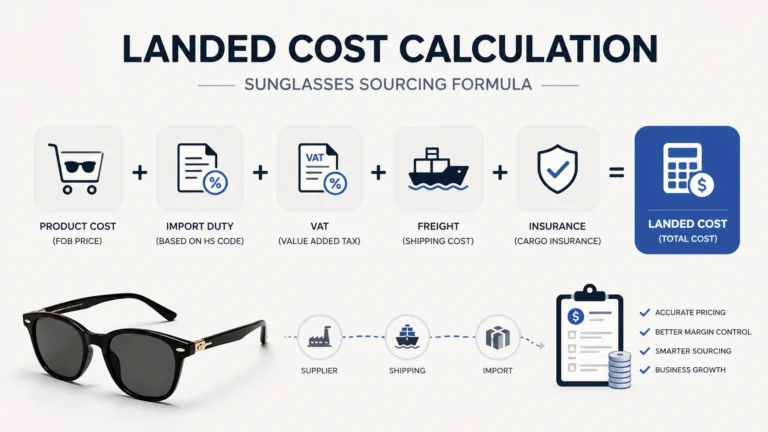
Landed cost = Unit cost + (Duty % × CIF) + Freight per unit + Insurance per unit + VAT on (CIF + Duty)
Example (simplified):
| Item | Value (USD) |
|---|---|
| Unit price (FOB) | $6.00 |
| Freight & Insurance per unit | $1.80 |
| CIF | $7.80 |
| Duty 3% | $0.23 |
| VAT 20% on (CIF + Duty) | $1.60 |
| Landed cost | $9.63 |
Use landed cost to set your wholesale floor. If your target wholesale is $25, then gross margin = $25 − $9.63 = $15.37 (61.5%).
How to Negotiate MOQs & Pricing
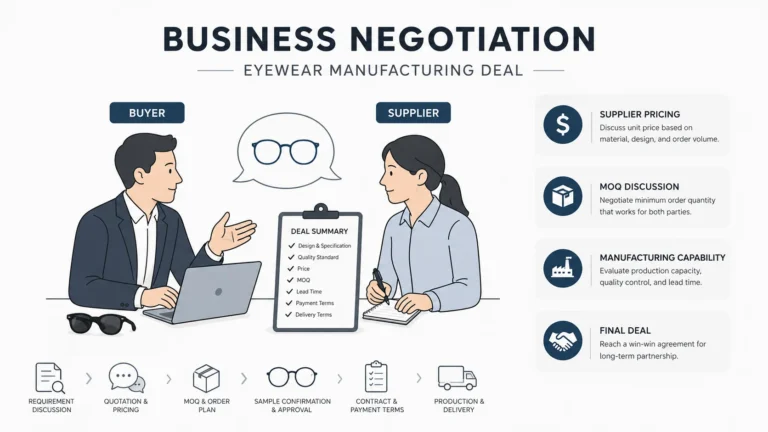
- Share forecasts: if you can commit to a 6‑month purchase plan, ask for stepped pricing or holding components.
- Split components: use shared cores (hinges, screws) across styles to lower MOQ per finished SKU.
- Pay more for lower MOQ: negotiate a higher per‑unit cost for smaller runs, with a rebate when you hit a volume tier.
- Ask for tooling amortization: spread tooling cost over first 3 runs or offer to co‑fund tooling for exclusivity.
- Offer logistics flexibility: consolidate shipments, accept staggered delivery to reduce supplier storage burden.
Small gestures—like confirming artwork promptly—earn you priority in the production queue and sometimes small discounts.
Sample Strategy: How to Test Without Overcommitting
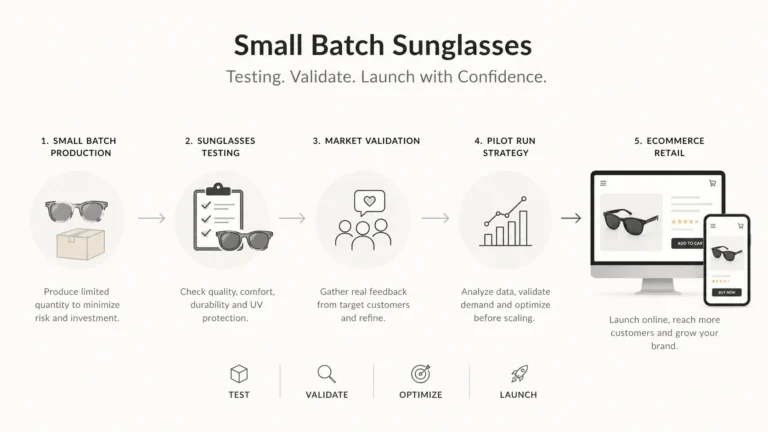
Design a sample plan that gives you the right answers with minimal cost.
- Start with 2 hero SKUs: pick two shapes and one optional tech variant (polarized or mirror).
- Order small pilot runs: 150–300 units to test conversion in a real channel.
- Test packaging: a better unboxing can move the needle more than a color variant.
- Reserve top colors: ask the factory to hold material for a small window so you can reorder fast.
When budgets are tight, trade some SKU breadth for better finish on hero pieces. Customers notice quality more than variety at first.
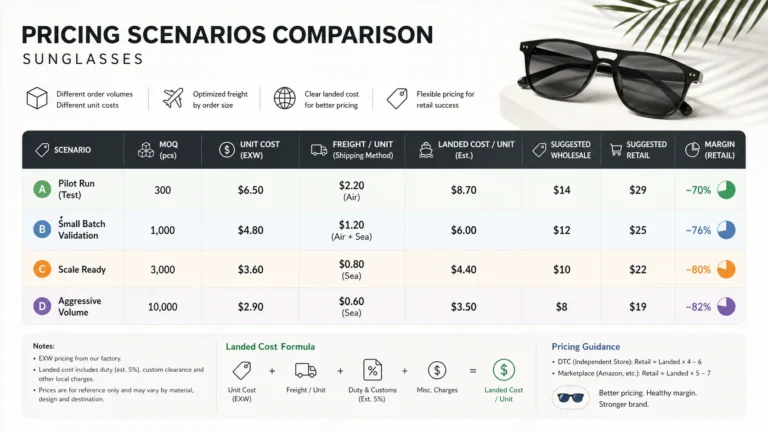
Pricing Scenarios — Examples
These simplified cases show how MOQ changes affect unit cost.
| Scenario | MOQ | Unit Cost | Freight/unit | Landed Cost |
|---|---|---|---|---|
| Small test (Designer) | 200 | $9.50 | $2.50 | $12.50 |
| Standard run | 500 | $6.50 | $1.80 | $8.30 |
| Large volume | 2,000 | $4.80 | $0.90 | $5.70 |
Observe how landed cost falls with volume. But remember—the capital tied to 2,000 units is much higher. Balance cash and risk accordingly.
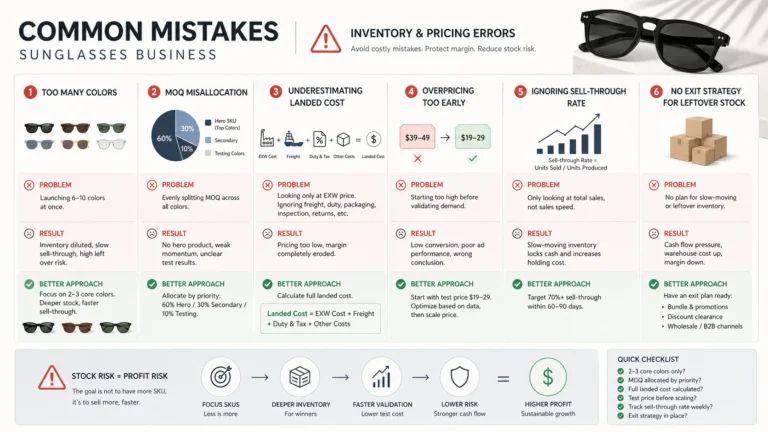
Common Mistakes Brands Make
- Too many colors on launch: spreads inventory thin and inflates tooling/stock risk.
- Ignoring landed cost: focusing on FOB price only misses duty and VAT impacts.
- Skipping T1 lock: failing to sign off on labels and packaging causes retail delays.
- No spare parts: not ordering a few hundred spare hinges or screws leads to warranty headaches.
Fixes are practical: smaller capsules, better pre‑flight checks, and a clear reorder plan.
Start Small, Think Systemically
MOQs and pricing are not just supplier details—they shape your product strategy. Start with a tight capsule, model landed cost, and keep a reorder plan. If you want, we can run the numbers for you and suggest a smart MOQ and pricing path based on your channels and target margin.
Need personalized help? Check our FAQ, explore Custom Service, or Contact Us to get a tailored MOQ & pricing proposal.
FAQ — Wholesale Sunglasses MOQ & Pricing
What is a reasonable MOQ for a new brand?
150–600 per style depending on finish. Designer finishes push higher. Start with 2–3 hero SKUs to test the market.
Can sample fees be deducted from first order?
Often yes. Many suppliers roll sample fees into the first production invoice if you place the full MOQ.
How should I set wholesale vs retail price?
Model landed cost first. Work backwards from your target MSRP or retailer margin. See pricing frameworks in this guide for two simple models.
Do you offer lower MOQs for ODM stock models?
Yes—ODM models often allow lower initial MOQ because they reuse existing tooling and components. Ask about availability and exclusivity terms.
Want a Free MOQ & Landed Cost Check?
Send product specs, target order quantity, and target retail. We’ll run a short model and recommend an MOQ strategy.