
CE • FDA • ISO • ANSI • REACH
Quality & Certification: Calm, Documented, Audit‑Ready
Compliance is a promise you make to your customer. We keep that promise measurable. This page explains how we build CE sunglasses for the EU, meet U.S. FDA certification expectations, and run as an ISO eyewear factory with traceable tests and tidy paperwork.
I’ve stood on the QC line when a lens fails impact by a hair. It’s a long night, but that’s the point: fail in the lab, not in the market. The methods below are the guardrails we use every day.
If you need a condensed client version of this page as a PDF for your retailers, ask us—we’ll tailor it to your assortment.
What “Compliant” Really Means in Eyewear
- Safety performance: UV protection, luminous transmittance category, impact resistance, optical power limits, polarization efficiency.
- Materials & chemistry: nickel release for metal parts, restricted substances (REACH), coatings stability.
- Fit & construction: frame robustness, hinge durability, stability at elevated temperature.
- Labeling & documentation: CE mark where applicable, warnings, batch code, importer info, Declaration of Conformity (DoC), test reports.
- Factory systems: ISO 9001 QMS, traceability, CAPA (corrective actions), retained samples.
In short: the product must perform, the paperwork must match, and your supply chain must be auditable.
CE Sunglasses for the EU Market
Most fashion sunglasses sold in the EU fall under the Personal Protective Equipment (PPE) Regulation. In practice, that means:
- Apply the harmonized standard: EN ISO 12312‑1 for sunglasses and related filters; EN ISO 12312‑2 when making specific claims for driving.
- Perform testing: UV protection, visible transmittance category (0–4), optical power, prism imbalance, scattered light, robustness, and where relevant, polarization efficiency and photochromic performance.
- Prepare documentation: technical file, bill of materials, risk assessment, and a signed EU Declaration of Conformity naming the standard.
- Marking & labeling: CE mark, model, batch/lot, company/importer details, warnings for Category 4 (not for driving), and care info.
We maintain templates for DoC and labeling so your retail boxes, inserts, and temple prints align. When a retailer asks for proof, you can reply in minutes, not days.
| Category | Typical VLT* | Use Case | Notes |
|---|---|---|---|
| Cat. 0 | 80–100% | Fashion, very low sun | Not for strong sunlight |
| Cat. 1 | 43–80% | Overcast | Light tint |
| Cat. 2 | 18–43% | Average sunlight | Everyday city wear |
| Cat. 3 | 8–18% | Strong sunlight | Most beach/driving lenses |
| Cat. 4 | 3–8% | Extreme glare | Not for driving |
*VLT: visible light transmission. Exact thresholds follow the latest standard. We align lens selection to your claims and channels.
EU resources: Eur-Lex (regulations database).
United States: FDA Impact Resistance & ANSI Z80.3
In the U.S., sunglasses are treated as a medical device category for impact resistance. The well‑known requirement is the FDA drop‑ball test, which verifies that lenses are impact resistant. We integrate this test into our release plan and keep retained samples with batch records.
- Impact resistance: lenses tested per FDA drop‑ball protocol (21 CFR 801.410).
- ANSI Z80.3: performance benchmark for non‑prescription sunglasses and fashion eyewear—optical power, prism, UV, impact, flammability.
- Labeling: warnings where needed (e.g., Category 4 not for driving), manufacturer/importer identity, batch traceability.
For big box retailers, it’s normal to be asked for both FDA impact records and an ANSI Z80.3 report from a third‑party lab. We supply both.
U.S. resource: eCFR for Title 21 details.

Frames & Contact Materials: Nickel Release, Stability, Fit
Metal touching skin must be comfortable and safe. We assess nickel release and run frame tests to ensure everyday robustness. A few highlights:
- Nickel release: tested for parts in direct and prolonged skin contact (e.g., temples, nose pads, hinges).
- Frame robustness: deformation and stress tests; long‑term hinge cycling; temple opening torque checks.
- Heat stability: exposure to elevated temperature to confirm shape retention and coating adhesion.
- Chemical resistance: sunscreen and sweat simulations on coatings to avoid premature wear.
On line walks, you’ll hear torque testers click at a consistent setting. If a hinge doesn’t return smoothly, it never reaches packing.
Inside an ISO Eyewear Factory: Control, Traceability, Calm
Certifications are only as good as the system behind them. We operate a quality management system aligned with ISO 9001. Practically, that means:
- Document control: specs, CAD, color approvals, and SOPs under revision control.
- Incoming QA: lenses, cores, screws, and coatings verified against AQL plans.
- In‑process QA: lens power checks (digital lensometer), UV and VLT sampling, hinge torque and alignment gates.
- Final QA: cosmetic inspection, lens/temple alignment, packaging line audits, barcode scan tests.
- Traceability: batch coding from lens blank to finished case; retain samples; CAPA on any deviation.
We also cooperate with ISO/IEC 17025 accredited labs for third‑party tests. When your retailer audits, the paper trail is ready.

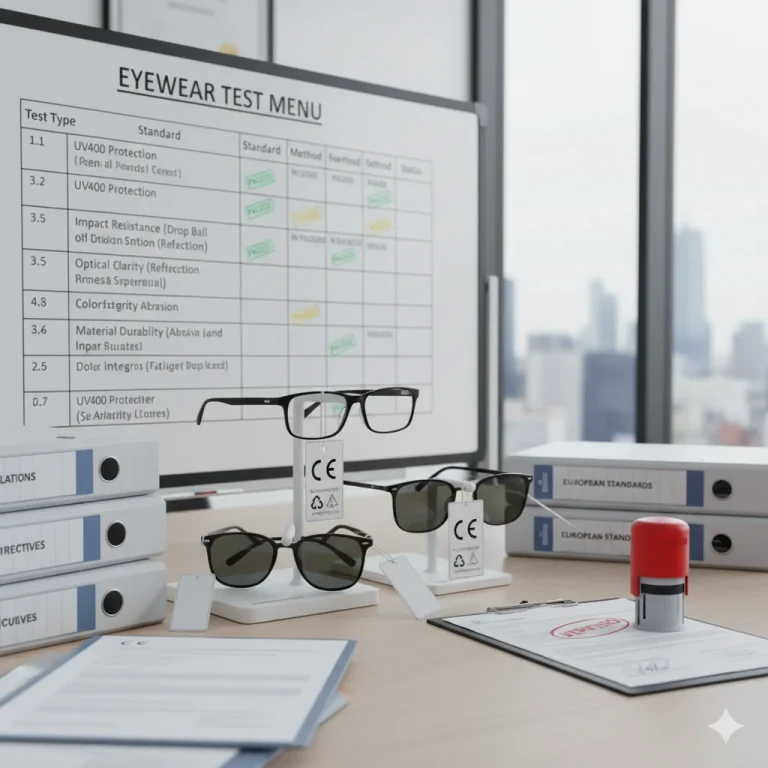
Test Menu: Map Your Claims to the Right Standard
| Claim / Component | EU (CE) | U.S. | Notes |
|---|---|---|---|
| UV protection | EN ISO 12312‑1 | ANSI Z80.3 | Verify UV400 or specified cutoff |
| Luminous transmittance (VLT) | EN ISO 12312‑1 | ANSI Z80.3 | Assign category 0–4; warnings for Cat. 4 |
| Impact resistance | Robustness per EN ISO 12312‑1 | FDA 21 CFR 801.410 + ANSI | Glass vs. plastic methods differ |
| Polarized lenses | EN ISO 12312‑1 | ANSI Z80.3 | Polarization efficiency, axis |
| Photochromic | EN ISO 12312‑1 | ANSI Z80.3 | Activation/deactivation behavior |
| Driving suitability | EN ISO 12312‑2 | ANSI notes | Signal recognition and color limits |
| Frames (robustness) | ISO 12870 (reference) | ANSI Z80.5 (frames) | Hinge cycling, deformation |
| Nickel release | EN 16128 | — | Skin contact parts only |
| Chemicals | REACH SVHC | State laws (e.g., Prop 65) | Manage via BOM + lab screens |
Tell us where you sell and what you want to claim. We’ll build a lean, no‑drama test plan that covers those boxes without over‑testing.
Labeling, Warnings & Paperwork That Survive Audits
- CE mark: applied to product or packaging; consistent with DoC and technical file.
- Importer details: EU/US/UK addresses where required; we maintain separate label sets per channel.
- Warnings: Category 4 “not for driving”, children’s age notes, care and cleaning.
- Barcodes & traceability: GS1 logic, batch code, carton marks, pallet map.
- Declaration of Conformity: one click away; signed, dated, revision‑controlled.
Nothing stalls a launch like missing importer text. We lock the artwork at T1 and gate production on label approval.

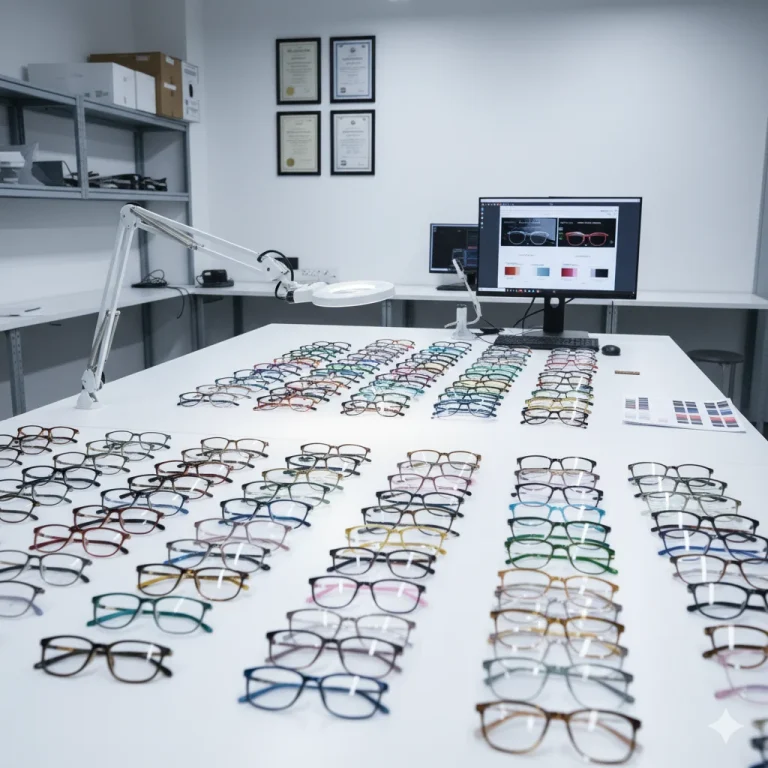
Case Story: The Scatter That Almost Killed a Colorway
We loved a pale green lens for a spring drop—until scattered light numbers came back high. On the bench, it looked dreamy; in the lab, it failed. We re‑balanced the dye load and adjusted cure time, then reran the panel. Pass. The color stayed, glare dropped, and the retailer signed off. Not all wins are visible on Instagram, but customers feel them on the road.
Moments like this are why we test early. Bad news in week three beats a recall in week thirteen.
Sustainability & Chemistry: Clear Choices, Clear Records
- REACH SVHC screening: we review BOMs and run targeted lab screens on coatings, inks, and plastics.
- Eco materials: bio‑acetate options, recycled cartons, soy‑based inks on packaging.
- Records: supplier declarations, lab results, and change logs kept by batch.
- Kids’ items: we map additional legal lines and test scope based on age grading.
“Sustainable” is not a sticker; it’s a paper trail. We keep it tidy so your marketing claims stay safe.
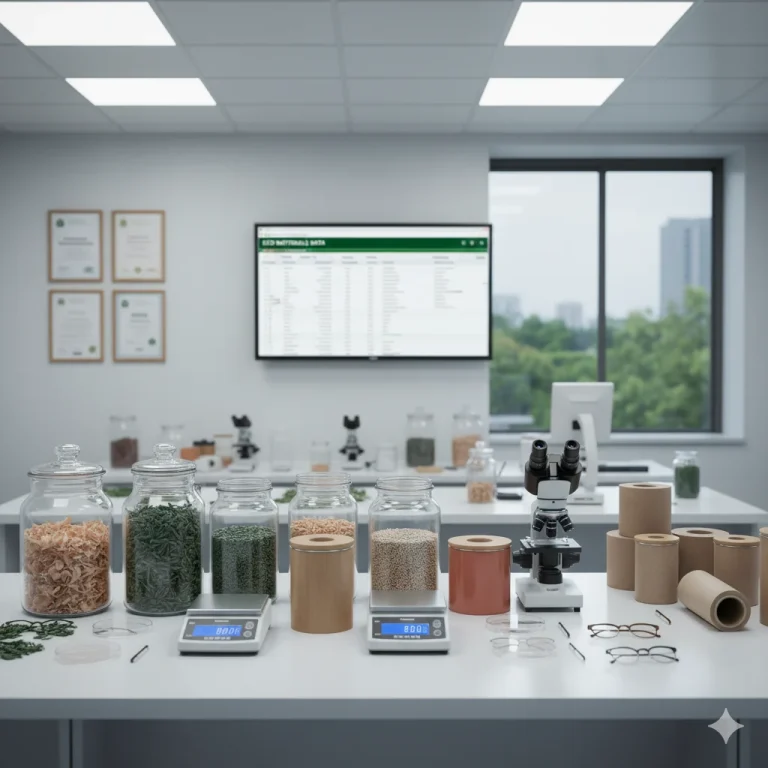

Third‑Party Labs & Reports: No Surprises
We work with accredited labs for final reports when retailers require them. We also run pre‑compliance tests in‑house so that the third‑party visit is a formality, not a gamble.
- Pre‑compliance: UV, VLT, lensometer checks, hinge torque, cosmetic inspection.
- Third‑party: full EN ISO 12312‑1 / ANSI Z80.3 scope as requested, plus FDA impact documentation.
- Review: we parse every line item, flag risks, and implement CAPA where needed.
If your buyer has a special protocol, send it early. We’ll mirror it in our T0–T1 plan so numbers match later.
Common Pitfalls We See (And How We Avoid Them)
- Wrong category claim: calling a Cat. 4 lens “great for driving.” We prevent this at artwork stage.
- Missing importer address: common with global assortments; we maintain region‑specific labels.
- Photochromic over‑promises: activation depends on UV and temperature; we set realistic copy.
- Polarization axis drift: misaligned film creates eye strain; we measure and gate by spec.
- Loose traceability: no batch code, no proof. We mark cartons and retain samples by lot.
Small mistakes turn into returns fast. Process saves the day here.


How We Work With Your Team
- Onboarding: map your regions, channels, claims, and retailer protocols.
- T0 sample: quick in‑house checks; tweak lens spec or coatings early if needed.
- T1 sample: lock labeling, warnings, importer text, and barcode logic.
- Pilot run: run the test plan; book third‑party lab if the buyer requires it.
- Mass production: AQL inspections, FDA impact batch records, retained samples.
- Shipment files: DoC, test reports, carton map, and photo pack delivered to you and your buyer.
We’ll never drown you in jargon. You’ll get clean files, named like a human: Brand_Model_Color_DoC_2025‑05.pdf.
Useful Resources We Actually Use
- Eur‑Lex for EU law and references to harmonized standards.
- eCFR for U.S. FDA impact rules (21 CFR 801.410).
- ISO catalogue for standards info.
- ECHA REACH for chemical guidance.
Bookmark these. They make conversations with buyers smoother because you can point to chapter and verse.

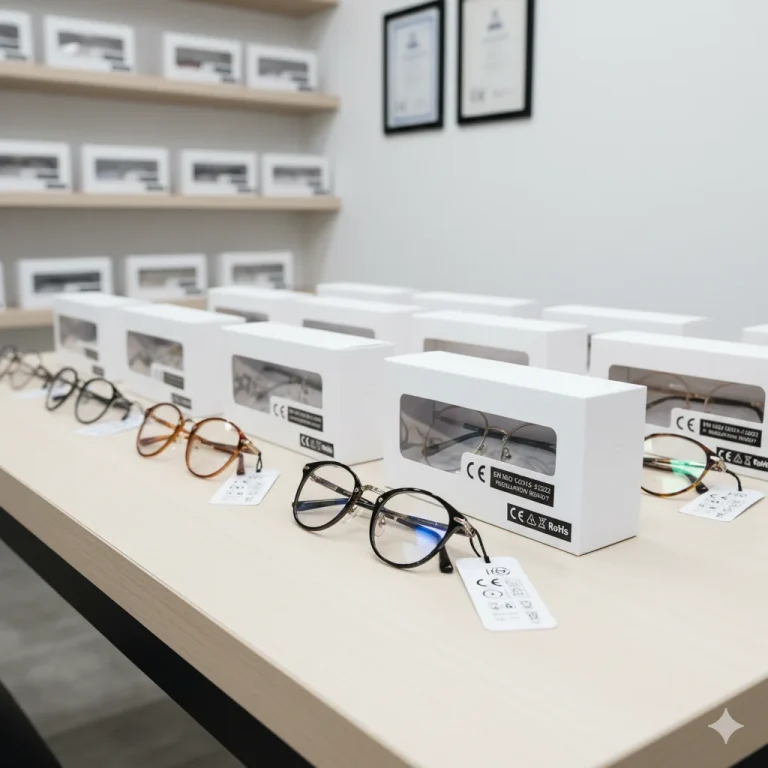
Compliance That Lets You Sleep
I’ve seen launches derailed by one missing warning line. It’s avoidable. With the right plan, compliance is quiet—it hums in the background while your campaign takes the spotlight.
Send us your regions and your claims. We’ll map the standards, run the tests, fix the small stuff, and ship with files that make buyers nod.
If you sell kids’ eyewear or sports wraps, also visit Sports Sunglasses and Prescription Sunglasses for category‑specific notes.
FAQ: Straight Answers
Do you provide CE sunglasses with a Declaration of Conformity?
Yes. Each qualifying model has a DoC that references EN ISO 12312‑1 and lists the responsible party. We align product markings and packaging to match.
Is there an FDA certificate for sunglasses?
The U.S. focus is impact resistance per 21 CFR 801.410 and performance per ANSI Z80.3. We provide impact records and third‑party ANSI reports where requested.
What does it mean to be an ISO eyewear factory?
It means we operate a quality system aligned with ISO 9001: document control, incoming/in‑process/final QA, CAPA, and traceability. We also work with ISO/IEC 17025 accredited labs.
Can you help with retailer audits?
Yes. We prep the file pack (DoC, test reports, label proofs, photos), host video line walks, and provide retained sample IDs. Most audits close in a single round.
What about UKCA?
We can supply CE and UK market markings as policies evolve. Tell us your channels and we’ll prepare region‑specific artwork.
Need CE, FDA & ISO Boxes All Ticked?
Share your target markets and timeline. We’ll build a lean test plan, align labels, and send a clean file pack—ready for buyers and customs.