If you ask ten buyers this question, you usually get ten different answers.
Some will say $1.50. Others will say $8. Some will even say $20+.
The truth is, they’re all right — depending on what they’re actually buying.
When I first started visiting eyewear factories, I thought there was a fixed “factory price” for sunglasses. Like a menu. One frame = one cost.
It doesn’t work like that.
Cost changes based on materials, volume, design complexity, and even how strict your quality requirements are.
And once you’ve seen enough production lines, you realize something simple:
sunglasses are not priced — they are built into cost layers.
Let’s break it down in a way that actually matches how factories think.
The Real Cost Structure Behind Sunglasses
A standard pair of sunglasses is not one cost. It is a combination of several small systems working together.
In most OEM factories, the cost is split into four main parts:
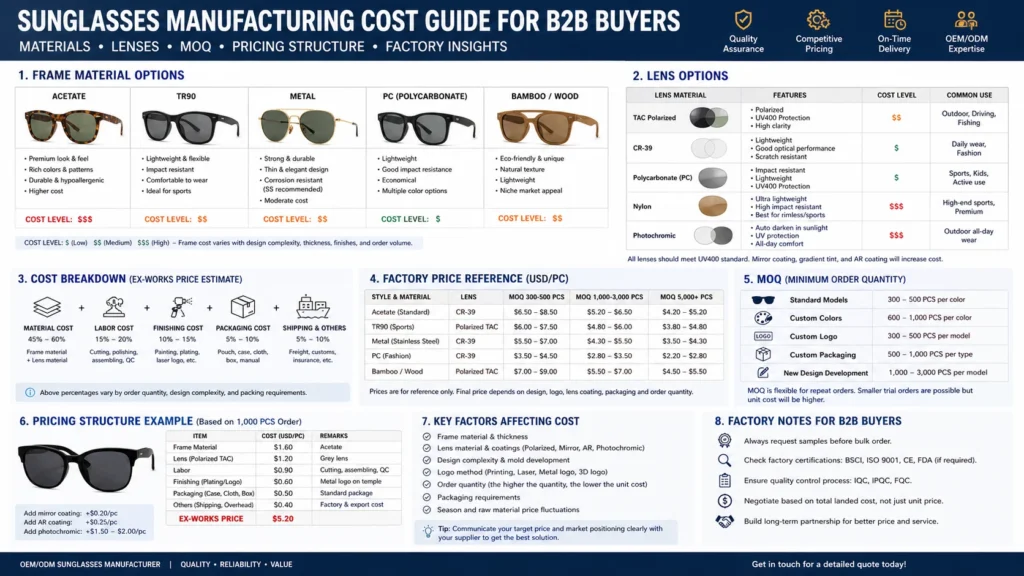
- Frame material
- Lens type
- Hardware & finishing
- Labor + quality control
Each layer can double or cut your final cost depending on how you choose it.
Let’s go deeper.
1. Frame Material Cost (Biggest Price Driver)
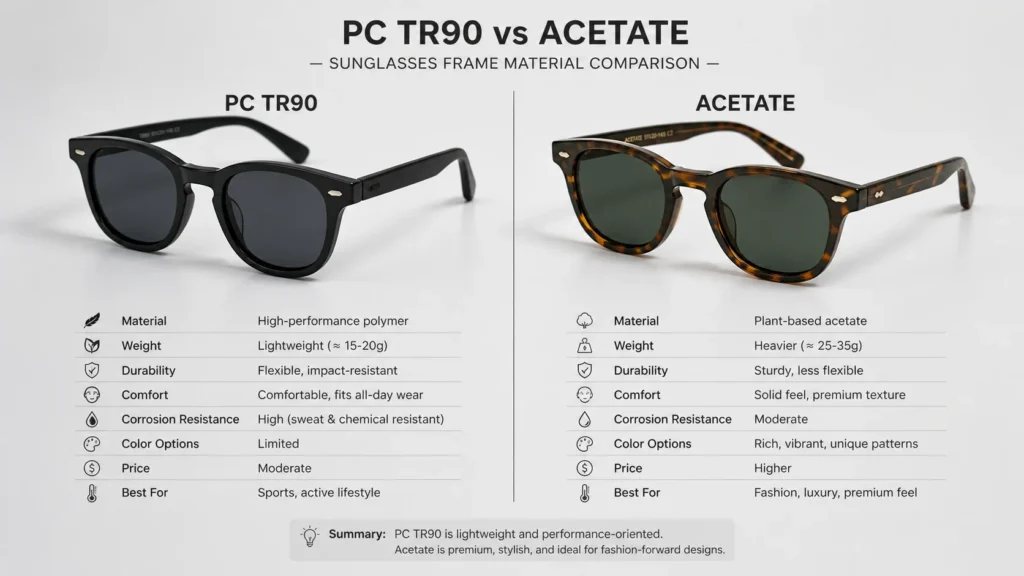
This is where most of the cost difference happens.
There are three common materials in bulk production:
PC (Polycarbonate)
This is the lowest-cost option.
It is lightweight, fast to mold, and widely used in entry-level sunglasses.
- Cost impact: Low
- Typical usage: promotional sunglasses, mass retail
TR90
This is the mid-range standard in most export factories.
Flexible, durable, and comfortable for long wear.
- Cost impact: Medium
- Typical usage: retail brands, Amazon sellers
Acetate
This is the premium material.
It requires more labor, longer polishing, and higher raw material cost.
- Cost impact: High
- Typical usage: fashion brands, boutique eyewear
In real production, just switching from PC to acetate can increase cost by 2–4x.
And that’s before lenses are even added.
2. Lens Cost (Where Many Buyers Underestimate)
Lens choice quietly changes both cost and positioning.
Most factories work with three main types:
PC Lens
- Cheapest
- Good impact resistance
- Basic UV protection
TAC Polarized Lens
- Most common in mid-range sunglasses
- Reduces glare, improves visual comfort
Nylon Lens
- Premium optical clarity
- Higher light transmission stability
- More expensive raw material
In practice:
- PC lens keeps cost low but limits brand positioning
- TAC lens gives the best balance for wholesale
- Nylon lens pushes product into premium retail category
A simple upgrade from PC lens to TAC polarized can increase unit cost by $0.30–$1.20 depending on volume.
It sounds small — until you multiply it by 10,000 units.
3. Hardware & Finishing Cost
This is where many “cheap sunglasses” quietly lose durability.
Components include:
- Hinges
- Screws
- Nose pads
- Surface coating
A standard hinge might cost only a few cents difference, but it changes failure rate significantly.
For example:
- Standard steel hinge → low cost, higher long-term looseness risk
- Reinforced spring hinge → higher cost, better durability
Finishing also matters:
- Spray coating
- UV curing
- Polishing time
Longer polishing cycles = higher labor cost, but better surface quality.
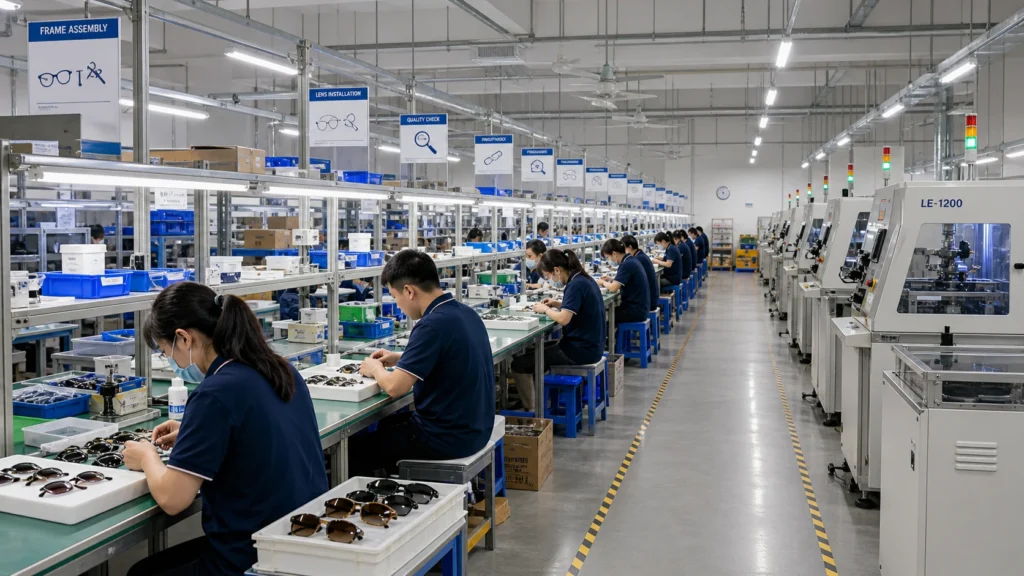
4. Labor + Quality Control Cost
This is the part many new buyers ignore completely.
Labor is not just assembly.
It includes:
- Manual alignment
- Lens fitting
- Frame adjustment
- Inspection
Then comes QC (quality control).
Factories with strict QC systems often reject 3–8% of production.
That rejection rate is part of your cost whether you see it or not.
If you want a deeper breakdown of how QC affects pricing, you can look at: sunglasses manufacturing guide
It explains how production steps directly shape cost stability.
Typical Wholesale Cost Ranges (Real Factory Numbers)
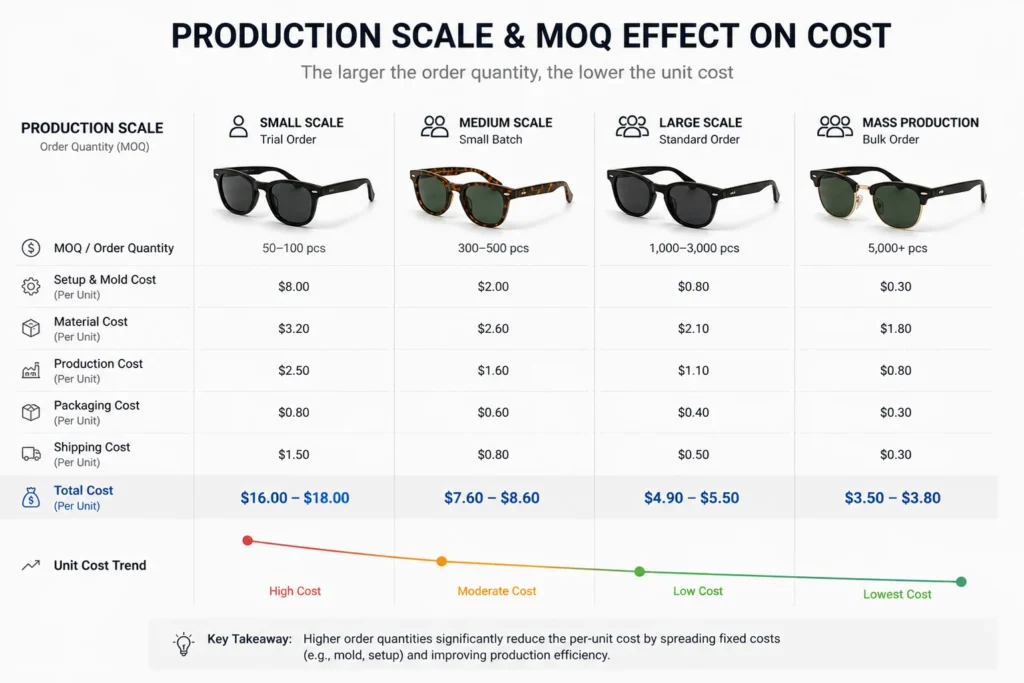
Let’s simplify it into real-world ranges based on volume:
- 300 pcs trial order: $1.80 – $3.50 / unit
- 1,000 pcs order: $0.90 – $2.20 / unit
- 5,000+ pcs bulk: $0.70 – $1.80 / unit
But these numbers shift fast depending on:
- Frame material
- Lens type
- Packaging requirements
- Custom branding
And sometimes even hinge selection changes the final cost more than expected.
Why MOQ Changes Everything
Minimum order quantity (MOQ) is not just a factory rule.
It directly changes pricing efficiency.
Lower MOQ = higher unit cost
Higher MOQ = material optimization + stable production cost
We explain this in more detail here: wholesale sunglasses moq pricing
Because MOQ is often the hidden factor behind “why your quote feels expensive.”
Why China Still Controls Most Cost Structures
If you look at global eyewear production, one thing becomes obvious quickly.
China is not just a low-cost option.
It is the system where cost optimization happens at scale.
Factories here don’t just reduce price by cutting corners.
They reduce cost by integrating steps.
One production line can handle:
- Cutting
- Polishing
- Assembly
- Packaging
No transfer delays. No outsourcing gaps.
That’s why even global brands rely on Chinese manufacturing partners.
If you want to understand how that structure works in detail: sunglasses manufacturer
It explains how vertical production changes both price and consistency.
The Real Cost Mistake Most Buyers Make
Most buyers think cost = unit price.
But factories think differently.
They calculate:
- Defect rate
- Rework time
- Material waste
- Production stability
A slightly cheaper unit price with unstable QC often becomes more expensive in real business terms.
Because returns and replacements eat margin quietly.
Final Breakdown (Simple View)
If we simplify everything:
- Low-end sunglasses → PC frame + PC lens
- Mid-range wholesale → TR90 + TAC polarized
- Premium positioning → Acetate + Nylon lens
This combination decides almost everything:
- Cost
- Brand positioning
- Market segment
- Return rate
Closing Thought
Manufacturing sunglasses is not about finding the cheapest price.
It is about understanding what drives that price in the first place.
Once you see the structure behind it — materials, lenses, labor, and scale — the numbers stop feeling random.
They become predictable.
And that is usually when sourcing decisions get easier.
Not cheaper. Just clearer.